
 Electroheating™ Rapid
Cooling
Electroheating™ Rapid
Cooling 



© 1998-2005
Raztek Corp.

 Today, Electroheating
™ technology is
revolutionizing the way the food and biotech industries approach heating for sterilization
and pasteurization. Electroheating™ is the product of more than ten years of engineering
and food processing research and development by Raztek Corporation. It is a proven
technology with industrial applications up and running. Our Electroheating™
customers are enjoying extensive benefits of the technology over conventional heat
exchanger methods: fast heating, uniform heating, and improved product quality.
Today, Electroheating
™ technology is
revolutionizing the way the food and biotech industries approach heating for sterilization
and pasteurization. Electroheating™ is the product of more than ten years of engineering
and food processing research and development by Raztek Corporation. It is a proven
technology with industrial applications up and running. Our Electroheating™
customers are enjoying extensive benefits of the technology over conventional heat
exchanger methods: fast heating, uniform heating, and improved product quality.
If you
process food or biotech products you
can improve your operating profits
and product quality
through Raztek’s Electroheating™ technology. We have demonstrated the success of
Electroheating™ with a wide variety of food products. Fruit juices and concentrates,
shelf-stable milk, puddings, soups, liquid egg products
and even beer and wine can be heated rapidly, uniformly, and effectively without risking the organoleptic
properties of the product. In addition, animal blood and other heat sensitive
proteinaceous fluids in the biotechnology industry have been successfully processed using
Electroheating™ technology
| Key Benefits | ||
|---|---|---|
 |
Very Rapid Heating.Typically a rise of 100°F (55°C) can be achieved in less than 0.1 second. This eliminates oxidation effects common in heat exchangers. | |
| Uniform Heating of the Product. Uniform current flow results in uniform heating of homogeneous products with no temperature gradient perpendicular to the fluid flow. The scorching and fouling common in heat exchangers are avoided. | 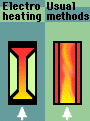 |
|

|
Continuous, Efficient Operation. The elimination of scorching, coagulation, and fouling favorably impacts product quality and reduces maintenance costs and system downtime. | |
| Longer Shelf Life.The ability to increase temperature and decrease holding time may result in longer product shelf life. | 
|
|

|
Improved Food Product. Taste, aroma, and nutritional value of the organic product is preserved, and in some cases, even enhanced. | |
| Small Equipment Footprint. Industrial scale installations typically consume only 1 - 2 square feet of floor space, considerably less plant space than conventional heat exchangers. | 
|
|

|
Instant On-off. There is no residual heat in the system when the current is shut off, while conventional heat exchangers retain heat when the operation has stopped. | |
| Accurate Temperature. Temperature is set and controlled with high accuracy and resolution of ±.1°c. | 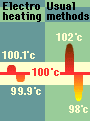
|
|
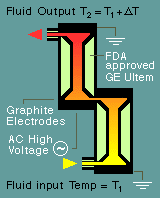
Electroheating™ is based on passing electrical current through a fluid food or biotech product by application of voltage across electrodes, which are placed in contact with the product. This method differs drastically from the conventional heating technologies that date back to the 19th century. In order to reach the desired temperature to pasteurize or sterilize the product using conventional methods, the temperature of the wall or tube where the product is heated must be significantly higher than the temperature of the product being heated. This increases the risk of fouling, coagulation and scorching of the product near the walls and leads to the formation of off-flavors and lowers the nutritional value of the product. Because Electroheating™ is based on passage of electricity through a food product, the electrical power is translated into heat as it passes along the flow line of the fluid. This allows rapid, uniform heating to occur without the risk of overheating or burning the product. This method rapidly kills microorganisms and viruses, while the taste, aroma and nutritional value of the product remains unaffected (click here for a complete documentation of Electroheating™ technology).
Sampling
Raztek's sampling system has been effectively used to determine thermal inactivation of enzymes and viruses as well as microorganisms in biological media. This sampling method has also served as an excellent tool to determine the optimal processing temperatures for heat-sensitive products. Pilot plant line samples could be as small as 100cc. A sampling system can be added to full-scale industrial lines.
Detailed Technical Information
For full description, refer to the following publictions:
Ohmic Heating of Fluid Foods